The Schengen Shuffle: The Honest Brits Guide
by The Floating Nomads
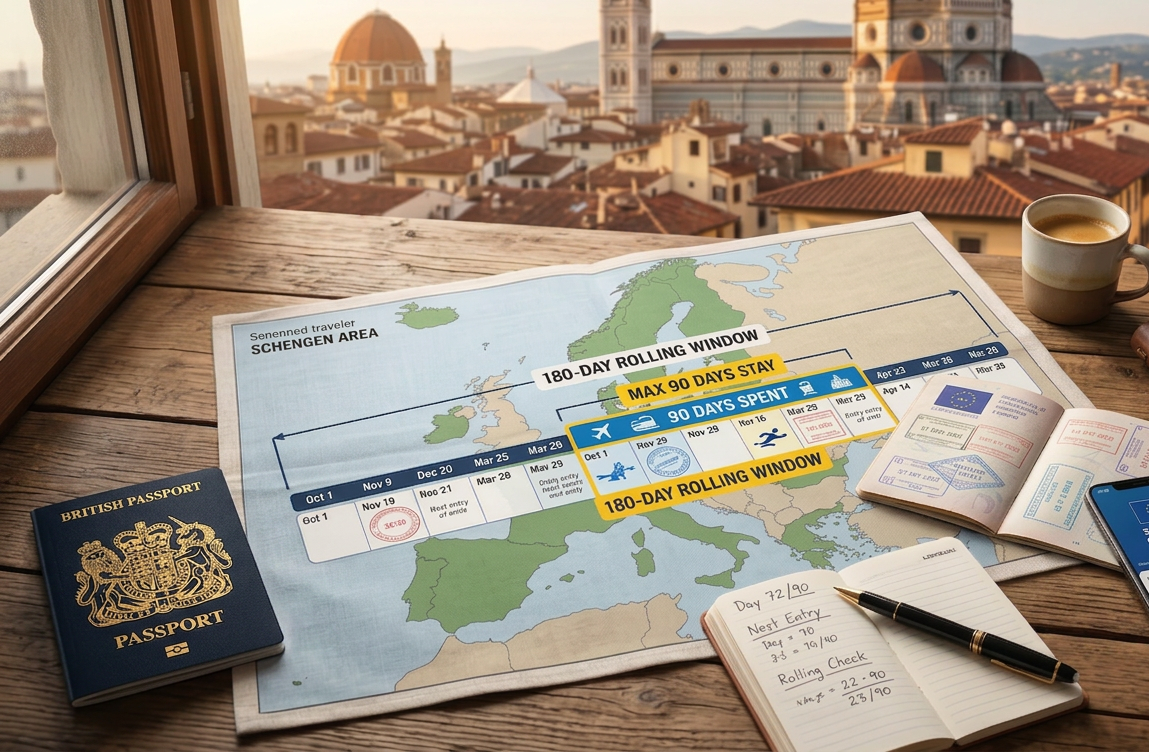
90 days in Europe, then you have to leave. Unless you understand the rules. We spent 150 days in Europe without breaking them once.
The Schengen 90-day rule is the single biggest constraint on long-term travel in Europe for anyone holding a non-EU passport. If you are from the UK, the US, Canada, Australia, New Zealand or most other countries outside the European Union, you are allowed 90 days inside the Schengen Area in any rolling 180-day period. Go over and you risk being banned from re-entering any EU country.
The Schengen Shuffle is the practical art of using non-Schengen countries to extend your time in Europe legally. Done properly, it can keep you on the continent for months at a time, taking you to places you would never have visited otherwise.
We have just spent 150 days doing exactly this. We started in Türkiye, spent time in Malta and Italy, escaped to Albania and Montenegro, flew to the French Caribbean, and came back across the Atlantic to Southampton. The only morning we technically left Europe was a few hours on the Dutch side of Sint Maarten. This is the guide we wish we had before we set out.
What This Guide Covers
This page answers the most common questions about the 90-day rule, the rolling 180-day window, which European countries are and are not in Schengen, and what is changing in 2026 with the new ETIAS requirement. The full downloadable guide goes further: which app we use to track our days, how we handle phones, currency and roaming across multiple non-Schengen countries, and a full country-by-country breakdown for planning your own Shuffle.
How the 90-Day Rule Actually Works
You get 90 days inside the Schengen Area in any rolling 180-day period. The rolling part is the bit that confuses most people.
It is not a fresh 90 days every six months. It is not a calendar reset on January 1st. On any given day, you look back over the previous 180 days and count how many of them you spent inside a Schengen country. If the answer is more than 90, you are over.
This means your Schengen days only "come back" gradually. Every day you spend outside Schengen, your earliest day inside Schengen rolls off the back of the 180-day window and becomes available again, 180 days later. If you spent a week in Spain six months ago, those days return to you now, one at a time, as the window moves.
Get this wrong and the consequences are serious. You can be denied entry, fined, or banned from re-entering the Schengen Area for up to three years. For anyone planning a long European trip, this is the single most important thing to understand.
Which Countries Are in Schengen?
As of 2026, the Schengen Area has 29 members. The 25 EU countries inside Schengen are Austria, Belgium, Bulgaria, Croatia, Czech Republic, Denmark, Estonia, Finland, France, Germany, Greece, Hungary, Italy, Latvia, Lithuania, Luxembourg, Malta, Netherlands, Poland, Portugal, Romania, Slovakia, Slovenia, Spain and Sweden. The four non-EU members are Iceland, Norway, Switzerland and Liechtenstein.
Bulgaria and Romania joined in full in January 2025. Ireland and Cyprus are both EU members outside Schengen. Ireland has an opt-out and uses the Common Travel Area with the UK instead. Cyprus is preparing to join Schengen, although no firm date has been confirmed.
Worth knowing: Portugal includes the Azores and Madeira. Both are part of Schengen for border control purposes. Time spent there counts toward your 90 days.
If you are visiting any of those 29 countries, your days are counting toward your 90.
Which European Countries Are Not in Schengen?
This is where the Schengen Shuffle becomes possible. Several European countries are not part of the Schengen Area, which means time spent there does not count toward your 90 days. The most useful for travel planning are the United Kingdom, Ireland, Albania, Montenegro, Bosnia and Herzegovina, Serbia, North Macedonia, Kosovo, Türkiye, Cyprus and Gibraltar.
Gibraltar is a British Overseas Territory and remains outside both the EU and Schengen. However, from 15 July 2026, a new UK-EU agreement applies Schengen-style border rules at Gibraltar's airport and seaport, effectively removing the land border with Spain. In practical terms, this means Gibraltar is no longer useful as a Schengen reset for travellers - your days will be checked against the Schengen system on arrival, even though Gibraltar itself is not technically inside it. Before July 2026 the old border system still applies, so the rules above only take effect from that date.
A few European territories technically sit outside Schengen but have soft borders or special arrangements that make them effectively Schengen for practical purposes. Andorra, San Marino, Vatican City, Monaco and the Isle of Man fall into this category. Do not plan to use them as a Schengen reset.
There is also one surprising category that is often missed. Martinique and Guadeloupe in the Caribbean are part of France, and therefore part of the European Union, but they are not part of the Schengen Area. We used both during our Shuffle.

What About ETIAS?
ETIAS (the European Travel Information and Authorisation System) is launching in late 2026 and will affect everyone reading this guide. It is not a visa. It is a pre-authorisation, similar to the US ESTA, that visa-exempt travellers will need to apply for online before entering the Schengen Area.
The cost is around €7, the application takes a few minutes, and the authorisation lasts three years or until your passport expires. ETIAS does not change the 90-day rule or how it works. You will still be allowed 90 days in 180. You just need ETIAS authorisation in advance.
We are watching the rollout closely and the downloadable guide includes the latest information on timing, costs, and how to apply.
Frequently Asked Questions
Is the UK in Schengen? No. The UK has never been in Schengen and left the EU in 2020. British passport holders are subject to the 90-day rule when visiting Schengen countries.
How do I track my Schengen days? We use the Schengen Simple app on our phones. It is the simplest tracker we have found. The full guide explains how we set it up, log entries and exits, and avoid the most common mistakes people make when counting their days.
Can I extend my 90 days? Not without applying for a long-stay visa or residency in a specific Schengen country, which is a separate process. The Schengen Shuffle does not extend your 90 days. It manages them by spending time outside Schengen between visits.
Is Türkiye in Schengen? No. Türkiye is not in the Schengen Area or the European Union. UK, US, Canadian, Australian and most other passport holders can stay for up to 90 days on arrival. It is one of the most useful non-Schengen countries for the Shuffle, especially in winter.
Are Martinique and Guadeloupe in Schengen? No. They are part of France and therefore part of the EU, but they are not in the Schengen Area. Time spent there does not count toward your 90 days.
Will Schengen days count differently after ETIAS? No. ETIAS is a pre-authorisation, not a visa. The 90-day rule remains exactly the same.
What happens if I overstay? Penalties range from fines to entry bans of up to three years across the entire Schengen Area. Border officials check entry and exit stamps and from late 2026 will use the new Entry/Exit System (EES) which automates the process. Do not overstay.
Key Facts
90 days allowed in any rolling 180-day period
Applies to UK, US, Canada, Australia, New Zealand and most non-EU passport holders
29 Schengen member countries as of 2026
Bulgaria and Romania joined in full in January 2025
Cyprus and Ireland are EU members outside Schengen
ETIAS pre-authorisation launching late 2026
Tracking app we use: Schengen Simple
Penalties for overstaying: fines, deportation, entry bans of up to 3 years
Watch Our Film
Download The Honest Brits Guide to the Schengen Shuffle
We have put together a full guide covering exactly how we tracked our days across 150 days in Europe, the apps we used for currency, roaming and esims in non-Schengen countries (which is more complicated than you would think), the country-by-country breakdown of how we structured our Shuffle, what is changing with ETIAS and the Entry/Exit System in 2026, and the mistakes to avoid.
Drop your email below and we will send it straight to you.